
100 kW Rooftop Solar System
A 100 kW rooftop solar system is a practical renewable energy solution for businesses with substantial daytime electricity consumption. It can help offices, factories, warehouses, hospitals, hotels, educational institutions, and other commercial facilities reduce their dependence on conventional grid electricity.
A well-designed solar plant uses available rooftop space to generate clean electricity for business operations. Depending on the system configuration and applicable regulations, surplus generation may also be exported to the grid.
EKA Synergy Solar provides end-to-end commercial and industrial solar EPC services, including site assessment, engineering, equipment supply, installation, commissioning, monitoring, and maintenance support. Every project is designed according to the facility's load profile, roof structure, operating hours, electrical infrastructure, and future energy requirements.
For businesses evaluating a 100 kW solar project, the main considerations include system cost, expected generation, available roof area, daytime electricity consumption, grid connectivity, and estimated savings.
Who Should Choose a 100 kW Rooftop Solar System?
A 100 kW installation can be suitable for facilities with significant electricity consumption, particularly where a large portion of energy is used during daylight hours. It can be considered for:

Manufacturing units and production facilities

Schools, colleges, and educational campuses

Hospitals and healthcare facilities

Office buildings and IT facilities

Industrial sheds and business parks

Warehouses and logistics centres
100 kW Solar System Cost
The 100 kW solar system cost varies according to the selected modules, inverter technology, mounting structure, electrical infrastructure, roof conditions, installation requirements, taxes, and project location.
- On-Grid: ₹45–₹55 Lakh – Businesses with reliable grid connectivity.
- Off-Grid: ₹55–₹70 Lakh – Facilities requiring solar generation with battery backup.
- Hybrid: ₹65–₹80 Lakh – Sites requiring greater energy independence.
Indicative figures only. Battery capacity, equipment selection, structural requirements, electrical work, taxes, and site conditions can significantly affect the final project price. The 100 kW rooftop solar price should therefore be determined after a detailed technical survey and project-specific quotation.
What Can Be Included in a 100 kW Solar EPC Cost?
Depending on the approved project scope, the quotation may include:
Earthing and lightning protection
Electrical protection equipment
Installation and commissioning
Mounting structures
Monitoring system
DC and AC cabling
Solar modules
Inverters
Types of 100 kW Solar Systems
On-Grid Solar System
An on-grid configuration works in parallel with the utility electricity network. Solar electricity is consumed by the facility, while surplus power can be exported according to the applicable state regulations and approved metering arrangement. This configuration is generally suitable for businesses that have a reliable grid connection and want to reduce their electricity expenses without investing in large battery storage.
Hybrid Solar System
An off-grid system operates independently of the utility network and relies on battery storage to supply electricity when solar generation is unavailable. It can be considered for remote facilities or locations where grid electricity is unavailable or unreliable. Because substantial battery storage may be required, the overall investment is typically higher.
Off-Grid Solar System
A hybrid configuration combines solar generation, battery storage, and grid connectivity. It gives businesses greater control over how electricity is generated, stored, and consumed. This option can be useful for facilities that want to reduce grid consumption while maintaining backup power for selected critical loads.
How Does a 100 kW Solar System Work?
A commercial rooftop installation typically operates through the following sequence:
Grid Interaction
For grid-connected projects, electricity can be imported from or exported to the utility network according to the approved configuration and applicable regulations.
On-Site Consumption
Generated electricity is first used by connected loads such as machinery, lighting, HVAC systems, computers, pumps, and other equipment.
Power Conversion
The inverter converts DC electricity into AC power suitable for the facility's electrical network.
Battery Storage
In hybrid or off-grid configurations, surplus electricity can be stored in batteries for later use.
Solar Energy Generation
Solar PV modules capture sunlight and convert it into DC electricity.
100 kW Solar System Energy Generation
The actual output depends on solar irradiation, location, weather conditions, panel orientation, shading, module efficiency, inverter performance, system losses, and maintenance.
These figures are indicative and should not be treated as guaranteed generation.
Under suitable Indian conditions, a system of this capacity may generate approximately:
- Daily generation: 400–500 units
- Monthly generation: 12,000–15,000 units
- Annual generation: 1,46,000–1,82,500 units
A detailed site assessment and location-specific generation simulation can provide a more accurate estimate for a particular facility. Two 100 kW solar plants may produce different annual output even when their installed capacity is identical because solar irradiation, shading, module orientation, system losses, and operating conditions vary from site to site.
Benefits of a 100 kW Rooftop Solar System
Improved Sustainability Profile
Commercial solar can support corporate sustainability initiatives and help organizations work toward their environmental objectives.
Long-Term Energy Savings
Solar projects can provide long-term financial benefits over their operating life when properly designed and maintained.
Cleaner Energy
Solar generation reduces dependence on conventional electricity sources and supports environmental sustainability goals.
Scalable Energy Solution
A properly designed project can be planned around present consumption while considering future business expansion.
Better Daytime Energy Utilization
Facilities operating during daylight hours can directly consume the electricity generated on-site.
Lower Electricity Expenses
Solar power can reduce the amount of electricity a business needs to purchase from the utility.
Reduced Grid Dependency
Generating electricity at the premises can reduce dependence on conventional grid power.
Technical Specifications of a 100 kW Solar Plant
| Specification | Typical Details |
|---|---|
| System Capacity | 100 kWp |
| Solar Modules | Quantity depends on selected module wattage |
| Inverter Capacity | Around 100 kW, depending on design |
| Estimated Daily Generation | 400–500 units |
| Estimated Annual Generation | 1,46,000–1,82,500 units |
| Approximate Roof Area | 10,000–12,000 sq. ft. |
| Panel Life | 25+ years, subject to manufacturer specifications |
| System Configuration | On-grid, hybrid, or off-grid |
The final equipment configuration depends on the selected module wattage, inverter architecture, roof layout, electrical requirements, and project design. The panel quantity can be estimated using:
100,000 watts ÷ selected module wattage = approximate number of panels
For example, the quantity will vary significantly depending on whether the project uses 400 W, 500 W, 550 W, or higher-capacity modules.
100 kW Solar System Roof Area Requirements
The 100 kW solar system roof area depends on the dimensions and efficiency of the selected modules, mounting arrangement, access pathways, maintenance clearance, and available shadow-free space.
As a preliminary planning estimate, around 10,000–12,000 sq. ft. may be required.
The actual usable rooftop requirement may be lower or higher depending on module efficiency, panel dimensions, roof geometry, and layout.
Before installation, the rooftop should be evaluated for:
- Structural strength
- Shadow-free area
- Roof orientation
- Access for maintenance
- Wind-load conditions
- Drainage and waterproofing
- Cable routing
- Inverter and electrical equipment placement
- Safety pathways and clearances
A structural assessment is particularly important for large commercial rooftop projects.
The total roof size should not be confused with usable solar roof area, as water tanks, skylights, ventilation equipment, parapets, shading, and maintenance pathways can reduce the space available for modules.
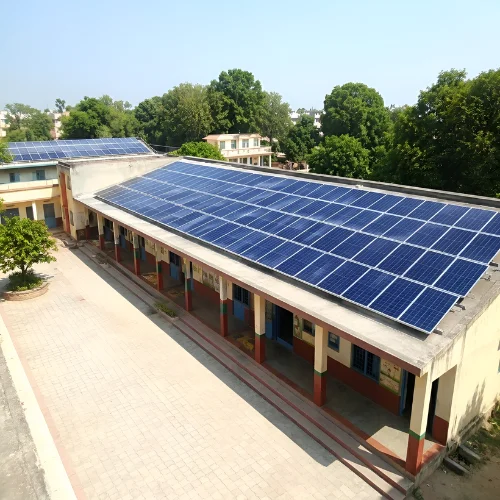
Components of a 100 kW Rooftop Solar System
Solar electricity can contribute to several areas of hospital operations depending on the system capacity and electrical design.
Electrical Protection Equipment
The system may include DC isolators, AC breakers, surge protection devices, earthing systems, lightning protection, and other safety equipment as required by the design.
Battery Storage
Battery storage is generally optional for an on-grid configuration but can be incorporated into hybrid or off-grid projects where backup or energy storage is required.
Monitoring System
A monitoring platform can track generation, system performance, equipment status, and operational data, helping facility managers identify abnormalities.
DC & AC Cables
Properly rated cables transfer electricity between the solar array, inverter, protection equipment, and building electrical infrastructure.
High-Efficiency Solar Panels
PV modules convert sunlight into DC electricity. The number of panels depends on the individual module capacity selected for the project.
Solar Inverters
Inverters convert DC electricity into AC power and manage the connection between the solar array and the facility's electrical system.
Mounting Structures
Galvanized steel or aluminium structures support the modules and maintain the required orientation and inclination.
100 kW Solar Installation Cost
The 100 kW solar installation cost is influenced by several project-specific factors, including:
- Roof type and structural condition
- Mounting structure requirements
- Cable length and routing
- Electrical panel modifications
- Earthing and lightning protection
- Inverter configuration
- Labour and site accessibility
- Utility interconnection requirements
- Monitoring and communication equipment
- For an accurate quotation, a site survey and technical assessment are recommended.
Applications of a 100 kW Rooftop Solar System
Warehouses & Logistics Centres
Large rooftops can provide useful space for solar modules while generating electricity for lighting, material-handling equipment, offices, and other loads.
Manufacturing Facilities
Solar generation can help offset daytime electricity consumption from production equipment, lighting, ventilation, and auxiliary systems.
Hospitals
Solar generation can support non-critical and general facility loads while helping healthcare facilities manage long-term electricity expenses.
Hotels & Hospitality Buildings
Solar electricity can help meet energy requirements for air conditioning, lighting, water heating, kitchens, and other hotel operations.
Educational Institutions
Schools, colleges, and campuses can use rooftop solar to reduce electricity consumption while demonstrating renewable-energy adoption.
Offices & IT Facilities
Solar energy can help offset electricity used by computers, servers, lighting, HVAC systems, and other office infrastructure.
100 kW Solar System Savings & ROI
Rather than applying a fixed payback period to every project, EKA Synergy Solar can prepare a project-specific financial assessment based on electricity bills and operating patterns. The financial performance of a commercial solar project depends on:
- Operation and maintenance expenses
- Export or metering arrangement
- Monthly energy consumption
- Daytime self-consumption
- Electricity tariff
- Solar generation
- Project investment
- Financing cost
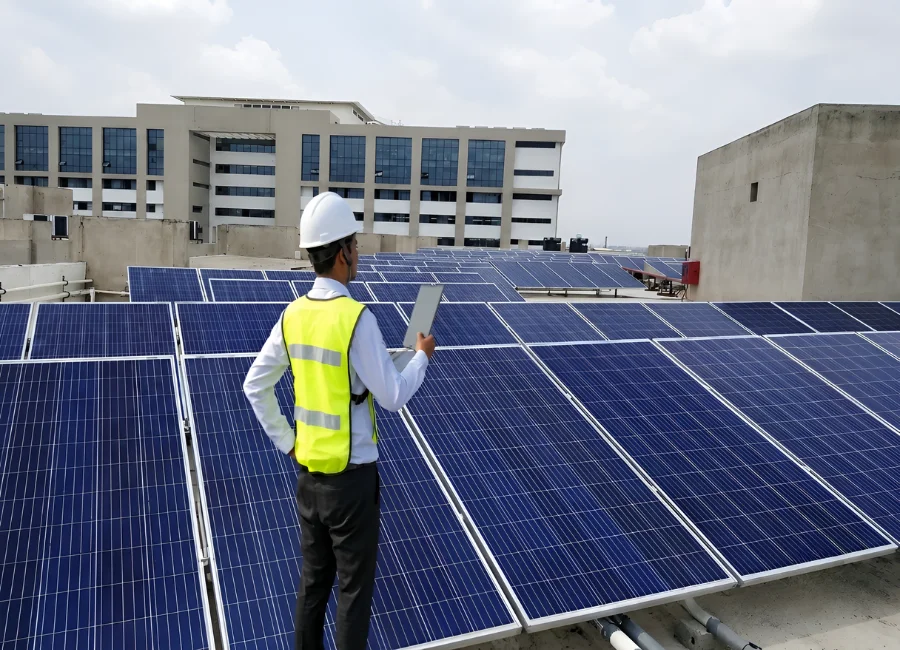
The 100 kW solar system payback period can then be estimated using actual consumption and expected generation. Factors considered in the ROI calculation include:
Annual Solar Generation → Electricity Offset → Annual Savings → Project Investment → Operating Costs → Payback
For a more realistic financial estimate, businesses should provide recent electricity bills, tariff details, operating hours, sanctioned or connected load, and available rooftop information.
Why Choose EKA Synergy Solar?
Customized System Design
Every project is designed around the facility's energy consumption, operating schedule, rooftop characteristics, electrical infrastructure, and future requirements.
Transparent Project Planning
We provide clear information about system specifications, project scope, installation requirements, expected performance, and estimated investment.
Quality Equipment
We help businesses select suitable solar modules, inverters, mounting structures, electrical protection equipment, and monitoring systems.
Quality Equipment
We select suitable solar modules, inverters, mounting systems, electrical components, and safety equipment based on project requirements.
End-to-End EPC Support
Our services cover feasibility assessment, engineering, procurement, installation, commissioning, and after-sales support.
Operation & Maintenance Support
Our team can assist with monitoring, preventive maintenance, troubleshooting, and long-term system performance.
FAQs About 100 kW Rooftop Solar
1. How much electricity can a 100 kW solar system generate?
Depending on location and operating conditions, a 100 kW installation may generate approximately 400–500 units per day. Actual production varies according to sunlight, weather, shading, panel orientation, equipment efficiency, temperature, and system losses.
2. How many solar panels are required for 100 kW?
The number depends on the wattage of the selected modules.
The basic calculation is:
100,000 watts ÷ module wattage = approximate panel quantity
For example, the required quantity will differ when using 400 W, 500 W, 550 W, or higher-capacity panels.
3. How much roof area is required for a 100 kW solar system?
Approximately 10,000–12,000 sq. ft. of usable rooftop area may be required as a preliminary planning estimate, depending on panel dimensions, module efficiency, mounting arrangement, access pathways, shading, and maintenance clearances.
A final layout should be prepared after a rooftop survey.
4. What is the cost of a 100 kW solar system?
The project cost depends on the system type, equipment selection, mounting structure, electrical work, roof conditions, installation requirements, taxes, and site-specific factors. A technical survey is required for an accurate quotation.
5. Can a 100 kW solar system power a factory?
Yes, it can offset a portion of a factory's electricity consumption. The actual contribution depends on the facility's connected load, operating hours, energy consumption, and solar generation.
6. Can a 100 kW rooftop system run during a power cut?
A standard on-grid system generally shuts down when the utility grid fails for safety reasons. Battery-backed hybrid or off-grid configurations are required when backup power is needed.
7. Is a battery required for a 100 kW solar system?
No. Batteries are not normally required for standard on-grid installations. They may be added when the project requires backup power or energy storage.
8. What is the lifespan of a 100 kW solar system?
Solar modules are generally designed for long-term operation, with many products offering performance warranties of 25 years or more. Inverter and other component lifespans vary by manufacturer and operating conditions.
9. Can a 100 kW system be installed on a warehouse roof?
Yes, provided the roof has adequate structural strength, sufficient usable area, suitable access, appropriate solar exposure, and suitable conditions for mounting the solar equipment.
10. Not necessarDoes a 100 kW solar plant require maintenance?
Yes. Routine cleaning, electrical inspections, monitoring, preventive maintenance, and periodic equipment checks help maintain system performance and safety.ily. Suitability depends on electricity consumption, available roof area, structural strength, solar exposure, electrical infrastructure, and applicable grid requirements.
11. Can the capacity be expanded later?
Expansion may be possible if the roof area, electrical infrastructure, inverter configuration, utility regulations, and original system design allow additional capacity.
12. How do I know if 100 kW is suitable for my business?
Review your electricity bills, daytime consumption, connected load, operating schedule, and available rooftop area. A professional feasibility study can then determine whether 100 kW is the appropriate capacity.