
Commercial On-Grid Solar System for Business
A commercial on-grid solar system helps businesses generate electricity from available rooftop or open space while remaining connected to the utility grid. It is particularly suitable for offices, hospitals, hotels, malls, IT parks, educational institutions, retail facilities, warehouses, and other commercial buildings with significant daytime electricity consumption.
EKA Synergy Solar provides complete residential solar solutions, including site survey, system design, installation, subsidy assistance, net-metering support, commissioning, and after-sales service.
Is On-Grid Solar Suitable for Your Business?
Commercial on-grid solar can be a good option when your facility has:
- High daytime electricity consumption
- Reliable grid connectivity
- Suitable rooftop or open space
- High commercial electricity tariffs
- Long operating hours
- A goal to reduce electricity costs
- Sustainability or renewable-energy targets
A professional assessment of electricity bills, load profile, roof area, and electrical infrastructure should be completed before selecting the system capacity.
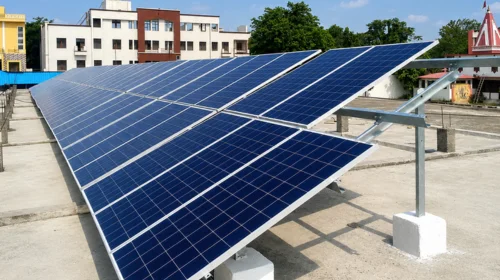
Key Benefits of Commercial On-Grid Solar
Scalable System Design
Where technically feasible, the solar capacity can be planned around current consumption while considering future expansion.
Low Routine Maintenance
On-grid systems generally require module cleaning, monitoring, electrical inspection, and preventive maintenance.
Reduce Electricity Costs
Solar electricity generated and consumed at the facility can reduce the amount of power purchased from the grid.
Lower Grid Dependence During Daytime
Businesses with strong daytime loads can use a significant portion of solar generation directly.
Better Use of Rooftop Space
Unused commercial rooftops can be converted into productive energy-generating assets.
Support Sustainability Goals
Commercial solar can support renewable-energy, ESG, CSR, and environmental initiatives.
How a Commercial On-Grid Solar System Works
The operating process is simple:
Grid Supplies Additional Power
When solar generation is lower than the facility demand, additional electricity is automatically drawn from the utility grid.
Surplus Power May Be Exported
Where applicable regulations and approved metering arrangements permit, excess solar electricity may be exported to the grid.
Solar Power Is Used by the Facility
Generated electricity is consumed by operating loads such as HVAC, lighting, computers, pumps, elevators, and other equipment.
Inverter Converts the Power
The solar inverter converts DC electricity into AC electricity suitable for the building.
Solar Panels Generate Electricity
PV modules convert sunlight into DC electricity.
Commercial Solar System Cost
The commercial on-grid solar system cost depends on:
- Required solar capacity
- Solar module technology
- Inverter configuration
- Mounting structure
- Roof condition
- Electrical infrastructure
- Cable routing
- Transformer and switchgear requirements
- Installation height and accessibility
- Grid interconnection requirements
Two projects with the same capacity may have different costs because site conditions and electrical requirements can vary significantly. A detailed site survey provides the most accurate project quotation.
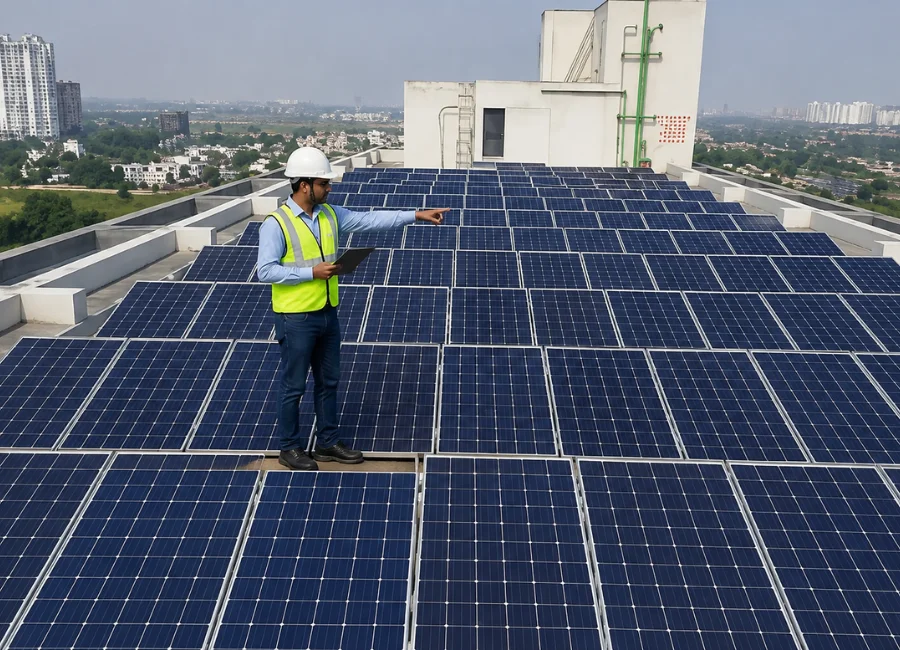
Commercial Solar Savings & ROI
The financial performance of a commercial solar project depends on:
- Current electricity tariff
- Daytime electricity consumption
- Annual solar generation
- Self-consumption percentage
- Project investment
- Export or metering arrangement
- Financing cost
- Operation and maintenance expenses
Instead of using one fixed payback period for every project, EKA Synergy Solar evaluates the actual electricity bills and operating pattern to prepare a project-specific savings and ROI estimate.
Main Components of a Commercial On-Grid Solar System
The final equipment configuration depends on the system capacity and facility electrical design. A typical commercial installation includes:
Transformer or switchgear where required
Earthing and lightning protection
AC/DC protection equipment
Commercial solar inverters
Mounting structures
Metering equipment
Monitoring system
DC and AC cables
Solar PV modules
Where Commercial On-Grid Solar Can Be Used

Schools & Colleges
Educational institutions can use rooftop solar for classrooms, administration blocks, computer labs, pumps, lighting, and campus facilities.

Shopping Malls & Retail Buildings
Solar generation can help reduce electricity consumption associated with HVAC, lighting, refrigeration, escalators, and other commercial equipment.

Offices & IT Parks
Solar can help offset electricity used by air conditioning, lighting, computers, networking equipment, elevators, and common areas.

Hotels & Hospitals
Facilities with long operating hours and substantial electricity consumption can use solar to support suitable daytime loads.

Warehouses & Business Parks
Large rooftops can provide useful installation space while solar electricity supports operational loads.
Important Things to Check Before Installation
These factors help determine the right solar capacity and system configuration. Before installing commercial solar, the EPC team should review:
Electricity bills and load pattern
Existing electrical panels
Future electricity demand
Metering requirements
Transformer capacity
Structural strength
Usable roof area
Grid connectivity
Cable routes
Roof shading
Does Commercial On-Grid Solar Work During a Power Cut?
Normally, no.
A standard on-grid solar system shuts down during a utility outage for electrical safety.
Businesses that need backup power should consider a properly designed hybrid solar system, battery storage, DG integration, or another backup arrangement according to their load requirements.
Commercial Solar EPC Process
EKA Synergy Solar follows a structured project process:
- Site and electricity-bill assessment
- Technical feasibility study
- System capacity selection
- Engineering and layout design
- Commercial proposal
- Equipment procurement
- Installation and electrical integration
- Testing and commissioning
- Monitoring and maintenance support
Why Choose EKA Synergy Solar?
Quality Equipment
Suitable modules, inverters, mounting systems, protection equipment, and monitoring solutions are selected according to project requirements.
Customized System Design
Each system is planned according to electricity consumption, operating hours, available roof space, and electrical infrastructure.
Transparent Project Planning
Businesses receive clear information about system capacity, project scope, expected generation, and installation requirements.
Complete EPC Support
Our services cover assessment, engineering, procurement, installation, commissioning, monitoring, and maintenance.
Commercial Solar Expertise
We provide engineering and EPC support for commercial and industrial solar projects.
Frequently Asked Questions
1. What is a commercial on-grid solar system?
It is a solar system connected to the utility grid that allows a business to use solar electricity while continuing to draw power from the grid when required.
2. Is commercial on-grid solar suitable for high electricity bills?
It can be particularly useful for businesses with high daytime electricity consumption because solar generation can directly offset part of the electricity purchased from the grid.
3. Does commercial solar require batteries?
A standard on-grid solar system generally does not require battery storage.
4. Can excess solar power be exported to the grid?
Surplus electricity may be exported where applicable regulations and approved metering arrangements allow it.
5. Can commercial businesses use net metering?
Eligibility depends on the applicable state regulations, DISCOM, consumer category, system capacity, and current policy.
6. How much roof space is required?
The required space depends on system capacity, module wattage, roof layout, shading, access pathways, and mounting arrangement.
7. What is the ROI of commercial solar?
ROI depends on project cost, electricity tariff, annual generation, self-consumption, financing, and operating expenses. A project-specific assessment provides a more reliable estimate.
8. Can solar be installed on a rented commercial building?
It may be possible with the property owner's permission and suitable contractual, technical, and utility arrangements.
9. How long does a commercial solar system last?
Solar modules are designed for long-term operation, with many manufacturers offering performance warranties of 25 years or more. Other equipment may have different service lives.