
Solar Panel Installation for Hospitals
Hospitals operate continuously and depend on electricity for patient care, medical equipment, air conditioning, ventilation, lighting, laboratories, diagnostic facilities, water pumps, elevators, and administrative operations. Solar Panel Installation for Hospitals can help healthcare facilities generate renewable electricity, reduce conventional power consumption, and manage long-term operating costs. A hospital solar project requires careful planning because every facility has a different electricity profile, rooftop area, equipment load, and backup requirement. A professional assessment can determine the appropriate solar capacity, system configuration, energy generation potential, and integration requirements.
Why Should Hospitals Install Solar Power Systems?
Hospitals are among the most energy-intensive types of buildings because many systems operate continuously. A well-designed solar installation can help reduce electricity expenses while supporting the facility's sustainability objectives.

Support Daytime Electricity Demand
Hospital facilities typically have significant daytime loads from air conditioning, ventilation, medical departments, laboratories, offices, lighting, and water systems. Solar generation can be used to support these requirements during daylight hours.

Reduce Hospital Electricity Costs
Solar generation can offset a portion of electricity purchased from the utility grid. This can help reduce recurring energy expenses associated with HVAC systems, lighting, pumps, administrative facilities, and other suitable loads.

Utilize Available Rooftop Space
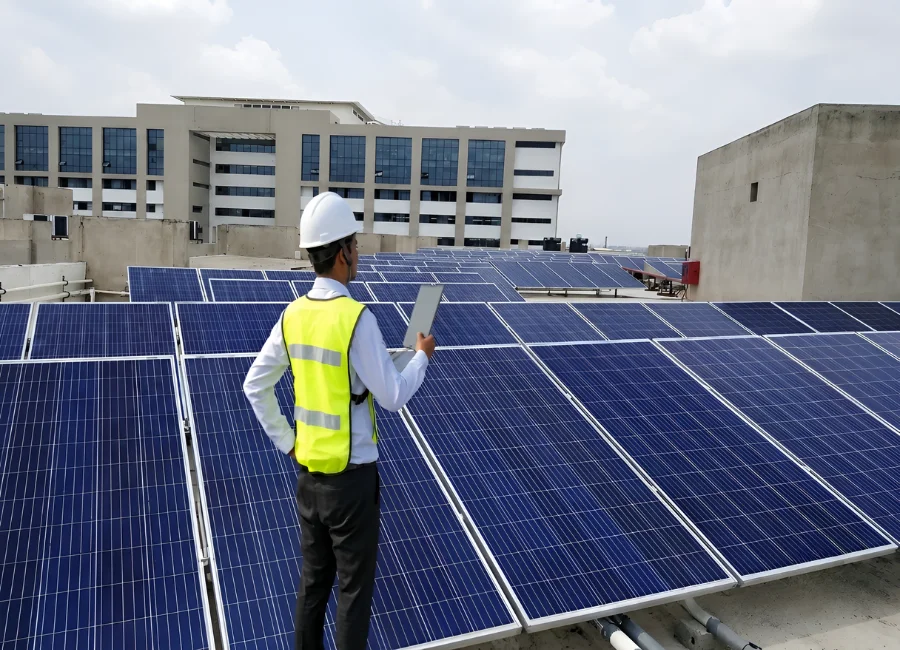
Large hospitals and healthcare campuses often have substantial rooftop areas. Suitable shadow-free space can be utilized for solar generation without requiring additional land.

Reduce Dependence on Grid Electricity
Generating a portion of electricity on-site can reduce reliance on conventional grid power and improve the facility's overall energy management strategy.

Support Sustainable Healthcare Operations
Renewable energy can help healthcare organizations reduce their environmental impact and strengthen their long-term sustainability initiatives.
Types of Solar Energy Solutions for Hospitals
On-Grid Solar System
An on-grid configuration works in parallel with the utility grid and supplies solar electricity to the hospital's connected loads. It can be suitable for facilities with reliable grid supply and substantial daytime energy consumption. Excess generation may be exported through an approved metering mechanism where applicable.
Hybrid Solar System
A hybrid configuration combines solar generation, grid electricity, and battery storage. It can provide additional energy storage capability for selected loads and may be considered when backup requirements are important.
Off-Grid Solar System
An off-grid system operates independently of the utility grid using solar generation and battery storage. This configuration may be suitable for healthcare facilities in locations where grid connectivity is unavailable or unreliable.
Applications of Rooftop Solar for Healthcare
Solar electricity can contribute to several areas of hospital operations depending on the system capacity and electrical design.
HVAC and Ventilation
Air conditioning and ventilation can represent a significant portion of healthcare facility energy consumption. Their operating schedules should be considered during energy analysis.
Medical and Diagnostic Facilities
Diagnostic departments and medical equipment can have varying operating schedules and electrical requirements. These loads should be carefully assessed during system planning.
Elevators and Common Facilities
Elevators, security systems, parking facilities, canteens, and other shared infrastructure can also form part of the hospital's overall energy profile.
Hospital Lighting
Patient rooms, operating areas, corridors, waiting areas, laboratories, offices, parking facilities, and other spaces require substantial lighting.
Administrative Operations
Computers, servers, networking equipment, printers, office lighting, and other administrative loads can be included in the energy assessment.
Water Pumping
Water supply, circulation, treatment, and pumping equipment can be considered while assessing the hospital's overall electricity requirements.
Laboratories
Laboratory equipment, refrigeration, ventilation, and supporting systems may contribute significantly to energy consumption.
Water supply, circulation, treatment, and pumping equipment can be considered while assessing the hospital's overall electricity requirements.
Administrative Operations
Computers, servers, networking equipment, printers, office lighting, and other administrative loads can be included in the energy assessment.
Water Pumping
Laboratories
Laboratory equipment, refrigeration, ventilation, and supporting systems may contribute significantly to energy consumption.
Solar Energy Solutions for Hospitals
Every hospital has a different load profile. Therefore, solar capacity should be determined through energy analysis rather than selecting a standard system size. A customized solution can consider:
Future Requirements
Planned building expansion, additional equipment, or increasing electricity demand.
Electrical Infrastructure
Existing panels, transformers, distribution systems, and interconnection points.
Rooftop Availability
Usable shadow-free area and access for installation and maintenance.
Backup Requirements
Whether battery storage or another backup arrangement is required.
Critical Loads
Equipment and systems requiring additional backup considerations.
Energy Consumption
Historical electricity bills and monthly consumption patterns.
Load Profile
Daytime, nighttime, peak, and base-load requirements.
Solar PV System for Hospitals
The appropriate capacity depends on the hospital's electricity demand, available installation area, solar resource, and electrical infrastructure.
| Planning Factor | Importance |
|---|---|
| Electricity Consumption | Establishes the overall energy requirement |
| Peak Demand | Helps evaluate electrical infrastructure |
| Daytime Load | Determines how much solar energy can be directly utilized |
| HVAC Consumption | Important due to high cooling and ventilation demand |
| Medical Equipment | Requires careful electrical load evaluation |
| Rooftop Area | Determines the available installation capacity |
| Shading | Affects solar generation |
| Transformer Capacity | Influences grid integration |
| Critical Loads | Helps determine backup requirements |
| Future Expansion | Prevents inappropriate system sizing |
Benefits of Solar Panels for Hospitals
Reduced Environmental Impact
Using renewable electricity can help reduce the facility's dependence on conventional power sources and lower its operational carbon footprint.
Stronger Sustainability Profile
Solar energy can support environmental goals and strengthen the healthcare organization's commitment to responsible energy management.
Long-Term Energy Savings
A properly designed system can continue generating renewable electricity for many years, supporting long-term energy cost planning.
Lower Electricity Bills
Solar generation can reduce electricity purchased from the grid and help manage recurring power expenses.
Improved Energy Management
Generation monitoring can provide useful information about solar production and system performance.
Reduced Grid Dependence
On-site generation can reduce the facility's dependence on conventional electricity for suitable loads.
Better Use of Hospital Rooftops
Suitable unused rooftop space can be converted into productive energy-generation infrastructure.
Solar Net Metering for Hospitals
Where permitted, an eligible solar installation may use an approved metering arrangement to manage electricity generated in excess of immediate consumption.
Eligibility, capacity limits, technical requirements, approvals, and electricity settlement mechanisms can differ according to the applicable regulations and distribution authority.
Hospitals should verify current requirements before finalizing the system configuration.
Why Choose EKA Synergy Solar for Hospital Solar Projects?
We develops customized solar projects based on the hospital's electricity consumption, available space, electrical infrastructure, operating requirements, and long-term energy objectives.
Detailed Technical Assessment
Rooftop availability, shading, structural considerations, electrical infrastructure, and installation requirements are evaluated before execution.
Quality-Focused Equipment Selection
Solar modules, inverters, mounting structures, cabling, and protection equipment are selected according to project requirements.
Complete Project Support
Support is available across energy assessment, engineering, approvals, installation, commissioning, monitoring, and maintenance.
Long-Term Technical Assistance
Ongoing service and technical support help healthcare facilities maintain efficient and dependable solar generation.
Site-Specific Solar Design
System capacity and layout are developed according to the facility's actual energy requirements and site conditions.
Professional Project Execution
Installation includes appropriate mounting, wiring, earthing, electrical protection, testing, and commissioning.
Frequently Asked Questions About Hospital Solar Systems
1. Can hospitals benefit from solar energy?
Yes. Hospitals with suitable rooftop or ground space and significant electricity consumption can use solar generation to reduce grid electricity usage and manage long-term energy costs.
2. Can solar power reduce hospital electricity bills?
Solar can offset a portion of grid electricity consumption. The actual savings depend on system capacity, solar generation, electricity tariffs, load profile, and applicable metering arrangements.
3. Can solar support hospital HVAC loads?
Yes. HVAC consumption can be included in the load assessment and considered while determining the appropriate solar capacity.
4. Can solar energy be used for medical facilities?
Solar electricity can contribute to suitable electrical loads, but critical medical equipment requires appropriate electrical design and backup arrangements based on operational requirements.
5. Does every hospital need battery storage?
No. Battery storage depends on the hospital's backup requirements, critical loads, grid reliability, and selected system configuration.
6. Can hospitals install solar on rooftops?
Yes, provided the rooftop has adequate structural strength, usable area, suitable access, and appropriate conditions for solar installation.
7. What determines the size of a hospital solar project?
Electricity consumption, peak demand, daytime load, rooftop area, shading, electrical infrastructure, budget, and future expansion requirements all influence system sizing.
8. What affects the cost of hospital solar installation?
System capacity, equipment specifications, installation conditions, electrical infrastructure, structural work, battery storage, monitoring, and grid-interconnection requirements can affect the project investment.
9. How long can a hospital solar system operate?
Solar modules are designed for long-term operation. Inverters, batteries, and other components have different operating lifetimes and maintenance requirements.
10. What maintenance is required after installation?
Regular cleaning, visual inspection, inverter monitoring, electrical checks, earthing inspection, performance monitoring, and preventive servicing are generally required.