
Solar Panel Installation for Housing Societies
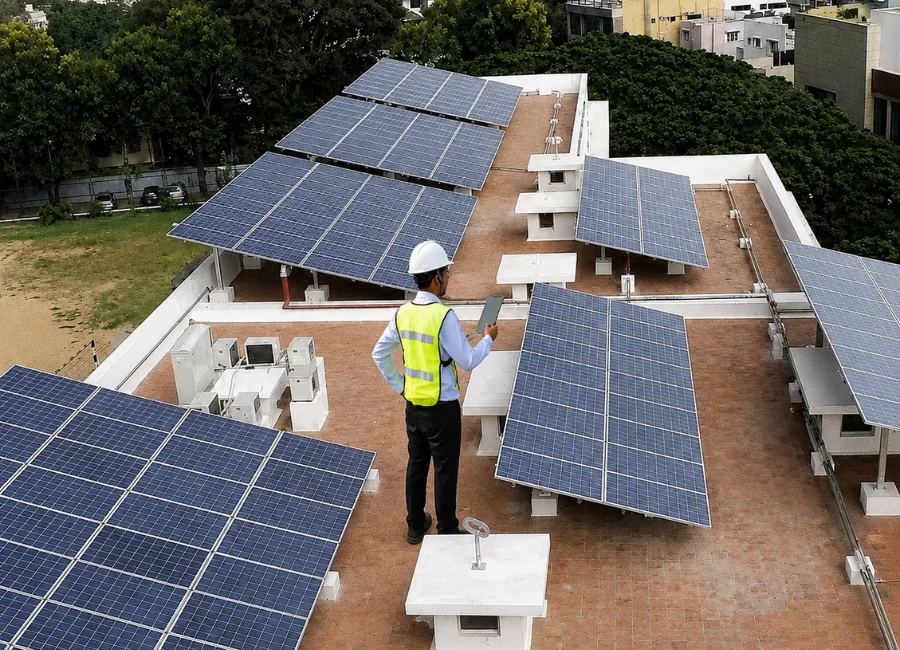
Housing societies consume substantial electricity for water pumps, lifts, common-area lighting, security systems, parking areas, clubhouses, and other shared facilities. Solar Panel Installation for Housing Societies enables residential communities to generate clean electricity on-site and reduce their dependence on conventional grid power. A properly designed solar project can help manage common-area electricity expenses while making productive use of available rooftop space. The right solution depends on the society's electricity consumption, daytime load, roof condition, available area, and backup requirements.
Why Should Housing Societies Install Solar Panels?
Solar Power for Housing Societies can support essential common-area loads while helping residential communities improve energy efficiency and long-term cost management.

Improve Long-Term Energy Planning
A well-designed solar project can provide renewable electricity over many years, helping societies plan their future energy expenses more effectively.

Make Better Use of Rooftop Space
Suitable shadow-free rooftops can be converted into productive areas for generating renewable electricity without requiring additional land.

Support Sustainable Community Living
Solar power can help residential communities adopt cleaner energy practices and reduce their operational environmental impact.

Lower Dependence on Grid Power
Generating electricity on-site can reduce the amount of conventional electricity required for eligible common-area loads.

Reduce Common-Area Electricity Bills
Solar generation can offset electricity consumed by pumps, lifts, lighting, security systems, and other shared facilities.
Solar System Options for Apartment Communities
The appropriate configuration depends on electricity consumption, grid availability, backup requirements, rooftop space, and applicable regulations.
On-Grid Solar System
An on-grid system operates alongside the utility grid and supplies solar-generated electricity to connected loads. It is suitable for societies with reliable grid connectivity and significant daytime consumption.Surplus generation may be exported to the grid through an approved metering arrangement, subject to applicable regulations.
Hybrid Solar System
A hybrid system combines solar panels, battery storage, and grid electricity. It can be considered when the society requires backup power for selected essential loads during grid interruptions.
Off-Grid Solar System
An off-grid configuration operates independently of the utility grid using solar generation and battery storage. It can be considered for locations where grid availability is limited or unreliable.
Applications of Solar PV for Housing Societies
Water Pumping Systems
Water pumps can represent a significant portion of common-area electricity consumption. Their operating schedules should be included when assessing the solar requirement.
Parking Areas
Lighting and other electrical requirements associated with parking spaces can be considered according to the system's available generation capacity.
Security Systems
CCTV cameras, access-control systems, security cabins, and other essential security equipment can be considered during system planning.
Common-Area Lighting
Solar power can support lighting requirements in corridors, stairways, parking areas, pathways, and other shared spaces.
Clubhouse and Amenities
Gyms, community halls, recreational areas, and other shared facilities can be included in the energy assessment.
Lifts and Elevators
Lift electricity consumption can be evaluated as part of the society's overall common-area load profile.
Housing Society Solar Installation Process
A structured project approach helps ensure that the solar system is technically suitable and aligned with the society's energy requirements.
Installation
Solar modules, mounting structures, inverters, cables, earthing, protection equipment, and associated electrical systems are installed.
System Design
Solar capacity, panel arrangement, inverter configuration, mounting structure, cabling, and protection systems are planned.
Monitoring
Solar generation and system performance are monitored after commissioning to identify potential operational issues.
Approvals and Metering
Required approvals and metering procedures are coordinated according to the applicable electricity regulations.
Electricity Consumption Assessment
Historical electricity bills and common-area loads are reviewed to understand energy consumption patterns.
Financial Evaluation
Expected generation, potential savings, project investment, and available financing models are reviewed.
Testing and Commissioning
The completed installation is tested for electrical safety and performance before commissioning.
Structural Assessment
The roof is assessed for mounting requirements, structural suitability, and installation safety.
Site Survey
The rooftop area, shading, orientation, accessibility, and installation conditions are evaluated.
Solar System Cost for Housing Societies
The project cost should be evaluated alongside expected energy generation and savings rather than considering equipment price alone. The financial assessment can include:
| Parameter | What to Evaluate |
|---|---|
| System Capacity | Based on common-area electricity demand |
| Solar Generation | Expected output based on site conditions |
| Electricity Savings | Reduction in grid electricity consumption |
| Project Investment | Equipment, installation and associated works |
| Battery Requirement | Based on backup requirements |
| Metering | Applicable grid-interaction arrangement |
| Maintenance | Long-term servicing and monitoring |
| Payback | Based on investment and actual savings |
Benefits of Solar for Housing Societies
Reduced Environmental Impact
Using solar power can help reduce dependence on conventional electricity and lower the community's operational carbon footprint.
Improved Sustainability
A renewable-energy project can support the society's broader environmental and energy-efficiency initiatives.
Long-Term Energy Savings
A properly designed system can continue generating renewable electricity over an extended operating period.
Better Rooftop Utilization
Suitable rooftops can be used to generate electricity without requiring additional land.
Lower Electricity Expenses
Solar generation can reduce grid electricity consumption for eligible common-area loads.
Reduced Grid Dependence
On-site generation provides an additional source of electricity for common facilities.
Solar Net Metering for Housing Societies
Where permitted, an approved metering arrangement may allow eligible solar projects to manage electricity generated in excess of immediate consumption.
Eligibility, technical requirements, capacity limits, approvals, and settlement mechanisms can vary according to the applicable electricity regulations and distribution authority.
The society should verify current requirements before finalizing the project.
Why Choose EKA Synergy Solar for Housing Society Projects?
We provides customized solar solutions based on the energy consumption, rooftop conditions, electrical infrastructure, and long-term requirements of residential communities.
Quality Components
Suitable solar modules, inverters, mounting structures, cables, and protection equipment are selected for dependable operation.
Customized Solar Design
System capacity and configuration are planned according to actual electricity consumption and available installation space.
Detailed Site Assessment
Rooftop conditions, shading, structural considerations, and electrical infrastructure are evaluated before project execution.
End-to-End Project Support
Support is provided across assessment, design, approvals, installation, commissioning, monitoring, and maintenance.
Professional Installation
The installation process includes appropriate mounting, wiring, earthing, electrical protection, and safety practices.
After-Sales Assistance
Ongoing technical support helps residential communities maintain reliable system performance after commissioning.
Frequently Asked Questions
1. Can solar power reduce electricity costs in a housing society?
Yes. Solar generation can reduce grid electricity consumption for suitable common-area loads, helping the society manage recurring electricity expenses.
2. What can solar power run in an apartment complex?
Depending on system capacity, solar power can contribute to water pumps, common-area lighting, lifts, security systems, parking facilities, clubhouses, and other shared loads.
3. How much rooftop space is required?
The required area depends on system capacity, panel wattage, layout, shading, mounting arrangement, and required maintenance access.
4. Is battery storage necessary?
Not always. Batteries are generally considered when backup power or energy storage is required for selected loads.
5. How is the solar capacity determined?
Capacity is determined by evaluating electricity consumption, daytime loads, rooftop availability, shading, electrical infrastructure, and future requirements.
6. Can a housing society use net metering?
This depends on the applicable electricity regulations, system configuration, metering rules, and eligibility of the project.
7. How much can a society save with solar?
Savings depend on system capacity, solar generation, electricity tariff, daytime consumption, common-area loads, and applicable metering arrangements.
8. How long does a solar system last?
Solar modules are designed for long-term operation, while inverters, batteries, and other components have different service lives and maintenance requirements.
9. What maintenance does a rooftop solar system require?
Routine maintenance generally includes panel cleaning, inspections, inverter monitoring, electrical checks, performance monitoring, and preventive servicing.