
Solar Panel Installation for Schools
Schools use electricity every day for classrooms, computer labs, smart learning facilities, offices, lighting, fans, water pumps, and other campus requirements. A well-designed solar project can help educational institutions generate clean electricity, reduce grid dependence, and manage long-term energy expenses.EKA Synergy Solar provides customized renewable energy solutions based on electricity consumption, available rooftop space, operating schedules, and the specific requirements of each institution.
Solar Panel Installation for Schools
Schools use electricity every day for classrooms, computer labs, smart learning facilities, offices, lighting, fans, water pumps, and other campus requirements. A well-designed solar project can help educational institutions generate clean electricity, reduce grid dependence, and manage long-term energy expenses.EKA Synergy Solar provides customized renewable energy solutions based on electricity consumption, available rooftop space, operating schedules, and the specific requirements of each institution.
Why Should Schools Choose Solar Energy?
Solar Power for Schools can provide both financial and environmental advantages while helping institutions make productive use of their available infrastructure.

Create Practical Learning Opportunities¬
A functioning photovoltaic installation can help students understand electricity generation, renewable energy, energy efficiency, and sustainability through real-world observation.

Reduce Electricity Expenses
Generating electricity during school operating hours can reduce the amount of power purchased from the utility grid and help manage recurring electricity expenses.

Support Sustainable Campus Operations
Renewable electricity can help schools reduce their dependence on conventional energy sources and strengthen their environmental initiatives.

Plan for Long-Term Energy Requirements
A properly designed system can provide consistent renewable electricity generation for many years, supporting long-term energy planning.

Make Productive Use of Rooftop Space
Suitable, shadow-free rooftops can be converted into energy-generating areas without requiring additional land.
Types of Solar Systems for Schools
The right configuration depends on electricity consumption, grid availability, backup requirements, rooftop conditions, and project objectives.
On-Grid Solar System
A Solar System for Schools connected to the utility grid can supply electricity to the school's loads during solar-generation hours. Depending on applicable regulations and metering arrangements, surplus generation may be exported to the grid.This configuration is suitable for institutions with reliable grid connectivity and substantial daytime electricity consumption.
Hybrid Solar System
A hybrid configuration combines solar generation, battery storage, and grid electricity. It can be considered when selected essential loads need backup during grid interruptions.
Off-Grid Solar System
An independent configuration combines solar generation with battery storage and can operate without depending on the utility grid. It may be suitable for educational facilities in locations where grid electricity is unavailable or unreliable.
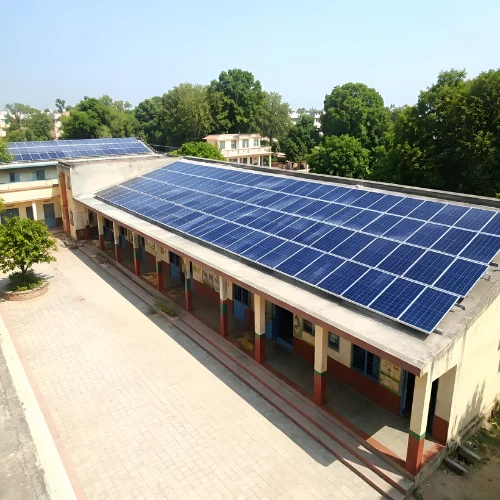
Benefits of Solar Power for Educational Institutions
Reduced Environmental Impact
Replacing part of conventional electricity consumption with solar generation can contribute to reducing the institution's operational carbon footprint.
Lower Electricity Bills
Solar-generated electricity can reduce the quantity of electricity purchased from the grid, helping educational institutions manage operating expenses.
Reduced Grid Dependency
On-site generation provides an additional electricity source and can reduce dependence on conventional grid power during solar-generation hours.
Better Use of Available Infrastructure
Rooftops that meet structural and technical requirements can be used for clean-energy generation without consuming additional ground space.
Practical Renewable Energy Education
Students can observe solar generation and energy monitoring in real time, connecting classroom concepts with a working energy system.
Support for Sustainable Education
A renewable-energy installation can complement environmental programs and help create greater awareness of responsible energy use.
Long-Term Energy Savings
A professionally designed project can generate electricity over an extended operating life and support long-term energy planning.
Clean Renewable Electricity
Solar generation uses sunlight to produce electricity without direct fuel combustion during operation.
Applications of Solar PV for Educational Institutions
A properly planned system can support several electrical requirements across a school campus.
Computer Laboratories
Electricity generated on-site can contribute to the requirements of computers, networking equipment, and digital learning infrastructure.
Smart Classrooms
Interactive displays, projectors, digital boards, and other educational equipment can be included in the school's energy assessment.
Administrative Offices
Office computers, printers, networking equipment, lighting, and other administrative loads can be considered during system sizing.
Libraries
Lighting, fans, computers, and other essential equipment can be supported according to the available system capacity.
Campus Facilities
Lighting, security systems, canteens, and other common facilities can also be considered when designing the project.
Water Pumping
Suitable water pumps can be included in the energy assessment when determining the overall solar requirement.
Classrooms
Solar-generated electricity can support lighting, fans, projectors, displays, and other classroom equipment.
Suitable water pumps can be included in the energy assessment when determining the overall solar requirement.
Classrooms
Solar-generated electricity can support lighting, fans, projectors, displays, and other classroom equipment.
Water Pumping
Campus Facilities
Lighting, security systems, canteens, and other common facilities can also be considered when designing the project.
Solar Energy for Schools: Subsidy, Financing & Net Metering
Financial incentives and metering provisions can vary according to location, institution type, system capacity, applicable government programs, and electricity regulations. Schools can evaluate:
Net metering or other approved metering arrangements
State-level renewable-energy programs
Applicable institutional incentives
Power Purchase Agreement options
CAPEX project models
Project financing
DISCOM approvals
RESCO models
How to Select the Right Solution?
Before selecting a system, school management should consider the institution's current and future electricity requirements.
Evaluate Rooftop Conditions
Check available area, shading, roof strength, orientation, access, and maintenance requirements.
Consider Future Expansion
Account for additional classrooms, laboratories, buildings, EV charging, or other planned loads.
Study Daytime Consumption
Identify how much electricity is used during school hours when solar generation is available.
Evaluate Financial Options
Compare project investment, expected savings, financing structures, and applicable incentives.
Determine Backup Requirements
Identify whether critical loads require battery-supported backup during grid interruptions.
Review Electricity Bills
Analyze historical consumption to understand monthly and annual energy requirements.
Solar Maintenance
Regular maintenance helps maintain energy generation, system reliability, and equipment performance. Typical maintenance activities include:
Cable and protection-device inspection
Generation monitoring
Periodic servicing
Electrical connection checks
Solar panel cleaning
Earthing inspection
Preventive maintenance
Inverter monitoring
Visual inspections
Why Choose EKA Synergy Solar?
EKA Synergy Solar develops customized solar projects according to the school's energy requirements, site conditions, and long-term sustainability objectives.
Detailed Site Assessment
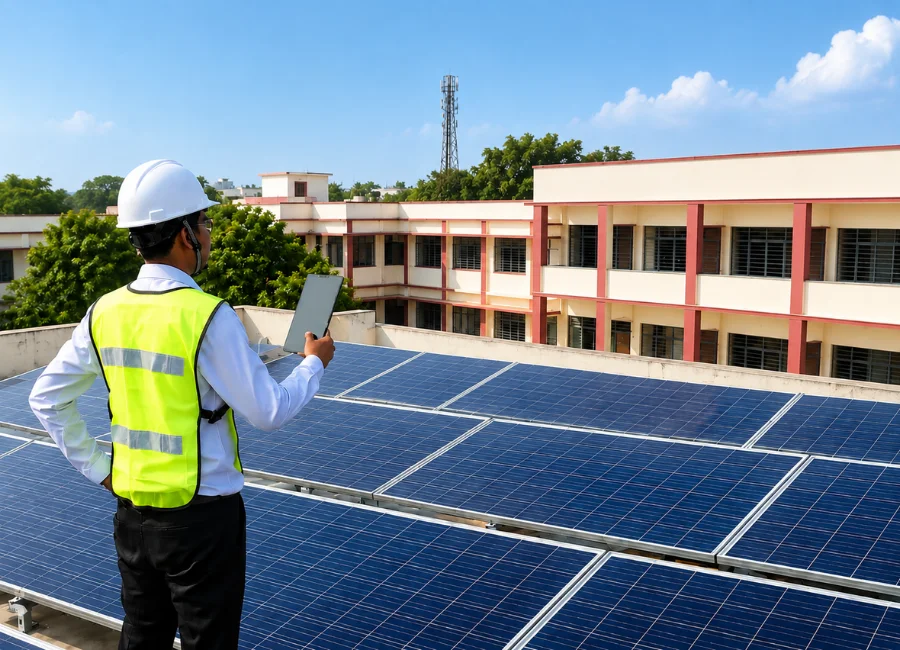
Our team evaluates rooftop conditions, shading, structural considerations, electrical infrastructure, and installation feasibility.
Customized System Design
We plan system capacity and equipment selection according to electricity consumption, available space, and project requirements.
After-Sales Assistance
Ongoing technical support helps schools maintain reliable operation and address maintenance requirements after commissioning.
End-to-End Project Support
We support the project from initial assessment and design through installation, commissioning, monitoring, and maintenance.
Quality Components
Suitable solar modules, inverters, mounting structures, cables, and protection equipment are selected for reliable operation.
Professional Installation
Installation is carried out with appropriate mounting, wiring, earthing, electrical protection, and safety practices.
Frequently Asked Questions (FAQs)
1. Why should schools install solar panels?
Solar can help schools reduce grid electricity consumption, manage energy costs, generate clean electricity, and provide students with practical exposure to renewable-energy technology.
2. How much can a school save with solar?
Savings depend on system capacity, electricity tariff, solar generation, daytime consumption, and the applicable metering arrangement.
3. How many solar panels does a school need?
The number depends on the required capacity, selected panel wattage, available rooftop area, and electricity requirements.
4. What size solar system is suitable for a school?
The appropriate capacity should be determined through electricity-bill analysis, daytime load assessment, site evaluation, and future energy requirements.
5. Can solar power run a school's computer laboratory?
Yes. A suitably designed system can contribute to computer laboratory electricity requirements according to the school's load profile and available capacity.
6. Can solar power support school air conditioners?
Yes, provided the system is designed according to the air-conditioning load, operating schedule, and overall electricity demand.
7. Does solar work during a power cut?
A conventional on-grid system generally shuts down during a grid outage for safety. Battery-backed hybrid or off-grid systems can provide backup for selected loads when appropriately designed.
8. Does a school need batteries?
Not necessarily. Batteries are generally considered when the institution requires backup power or energy storage.
9. Can schools export excess solar electricity?
The availability of surplus-energy export depends on the applicable electricity regulations and approved metering arrangement.
10. Are subsidies available for school solar projects?
Eligibility depends on the institution, location, system configuration, applicable government scheme, and prevailing regulations. The specific project should be assessed before claiming an incentive.
11. How much does solar installation cost for a school?
The cost depends on capacity, equipment, rooftop conditions, electrical infrastructure, mounting requirements, installation complexity, and battery storage where applicable.
12. How long do solar panels last?
Solar panels are designed for long-term operation and can continue generating electricity for decades when properly installed and maintained.
13. What maintenance does a school solar system require?
Routine maintenance generally includes panel cleaning, inspections, inverter monitoring, electrical checks, performance monitoring, and preventive servicing.